Austrian photographer Wolfgang Lehrner captures Mexico City

The brutal aesthetics hidden within the familiar of everyday life, the globalized sameness of todays metropolises, and the way these megacities are meticulously planned are central themes in Wolfgang Lehrner's work. As great fans of his immaculate eye, we have shared his beautiful Athens-shot series 'Metro-Polis' here before. Lehrner’s latest ambitious project named 'City Without Name' is another incredible addition to his body of work. Capturing different aspects of everyday life in Mexico City in his unique manner, he takes the spectator from the heart of the city all the way to the periphery and back again; always finding an extraordinary level of abstraction, straight lines, anonymous people on the move through the constructions erupted out of a seemingly infinite mix of glass, steel and concrete. Lehrner captures moments in Mexico City that are so familiar, yet feel as if taking place on a different planet. Evermore questioning the utopian concept of modernity, he portrays a city without distinct limits, always finding a way to mould these uniform and monotone moments into intrinsically captivating images. [ Continue reading ]
Cape Town's Grain Silo by Thomas Heatherwick
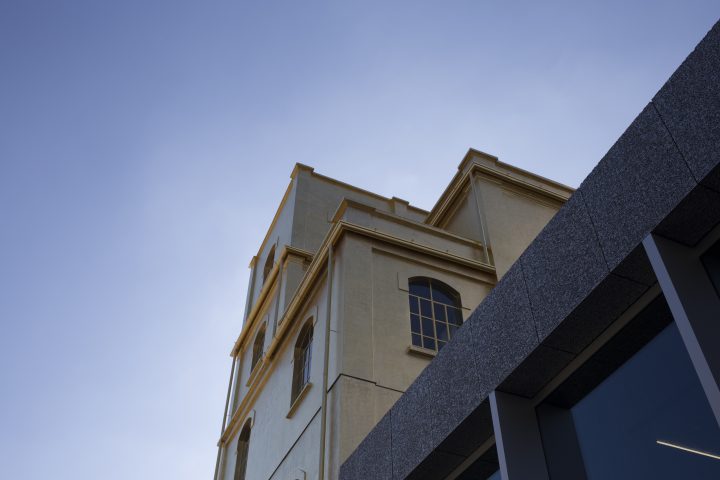
Last weekend, the extraordinary Zeitz Museum of Contemporary Art Africa (MOCAA) in Cape Town, South Africa opened its doors for the public. The museum is set to become the world's most important exhibition space for African art, and with its iconic building by Heatherwick Studio it already draws the needed attention. The London-based firm transformed the building, both on the outside and inside, from a dead industrial structure into a mind-bending icon, instantly joining the Pantheon of some of the most beautiful museum buildings to be found all over the globe. [ Continue reading ]
Park Groot Vijversburg is a beautiful park located in the small town of Tytsjerk, in the northernmost province of The Netherlands named Friesland, which has been open to the public since 1892. Throughout the year, the park hosts events such as art exhibitions, musical performances, church services and excursions. With a rich history of inhabiting a variety of flora and fauna, the heart of Park Groot Vijversburg has always been a neoclassicist mansion in the center of the park. With the number of visitors growing significantly in the last two decade, six years ago Tokyo-based architect Junya Ishigami and Marieke Kums of Rotterdam practice Studio Maks were given the assignment to design an accommodation next to the villa that would enable Park Groot Vijversburg to host the bigger crowds.
Last May was the official opening of the new addition, next to other significant changes and additions to the park, resulting in an inspirational new face for the public area, having become one of the more beautiful spots in the country. But above all, what stands out within the reinvigoration Park Groot Vijversburg is the extraordinary vision that was materialized by Ishigami and Kums, which consists of three intersecting glass corridors that grow out of a sunken, triangular-shaped visitors centre — forming a deeply inspirational structure that, in the words of Ishigami: "melts into the environment," and is among the most impressive we have seen erupted in The Netherlands in a long time. [ Continue reading ]
Exactly two months ago we travelled to Milan (unexpectedly as a road trip, due to a storm in Amsterdam) to visit our friend Roel. Looking back at that weekend in February once more; it is safe to conclude that it turned out to be a greatly inspirational (Jos Brink-themed) couple of days, in which we were able to see some of nature's most beautiful hidden treasures in the marble quarries of Carrara ánd some of humankind's more interesting creations when we visited the sweaty Pinacoteca di Brera; the Pirelli HangarBicocca to, for the first time, see Anselm Kiefer's mysterious towers up close; and (finally!) Rem Koolhaas' Fondazione Prada Foundation, where we had the chance to experience the deeply haunting and still extremely relevant 'Kienholz:Five Car Stud' exhibition and sat down with Boglioli's former Creative Director Davide Marello for an enlightening conversation on the state of Italian tailored menswear fashion. The low, late winter sun was out, the sky was blue and the air was cool: this is that rather perfect Saturday at the incredible Fondazione Prada Foundation in captures by Joachim. [ Continue reading ]
At the end of last month, American artist and filmmaker Doug Aitken presented his latest incredible creation to the public, which at this moment is our favorite work he has created thus far. Part of the unique Desert X exhibition, that features a curated selection of site-specific works in the Coachella Valley in the Southern California desert, his creation named 'Mirage' is a installation utilizing the form of a ranch style suburban American house composed of reflective mirrored surfaces. It distills the recognizable and repetitious suburban home into the essence of its lines, reflecting, and disappearing into the vast western landscape. As movement was the driving force behind the settling of the American West, and the long flat vistas that stretched toward the Pacific shaped the ideology behind this iconic embodiment of American architecture, Aitken found inspiration in the history of the site to create his vision on reflection. The specific California Ranch Style, which is unique to the West, was informed by the ideas of legendary architect Frank Lloyd Wright, who believed that architecture should be both in and of the landscape.
In the 1920s and ‘30s a small inspired group of architects working in California and the West created the first suburban ranch style houses, fusing Wright’s fluid treatment of spaces with the simple one-story homes built by ranchers. After World War II, the ranch style’s streamlined simplicity gained popularity and commercial builders employed a simplified assembly line approach to create this efficient form, matching the rapid growth of the suburbs. The mass-produced ranch home became a familiar sight across the country, the style filling the American landscape as quickly as each new subdivision was built and was reinvented for the 21st century by Aitken as the ultimate tool for reflection on the rich past of this area. For those visiting Southern California before the 31st of October make sure not to miss this unique work in the middle of the desert, offering a unique perspective in a place where you are doomed to meet yourself anyway. [ Continue reading ]
We have been following the very talented Japanese designer Yusuke Seki for a couple of years in which he is constantly taking his work to the next level, whether it was for the Interior Design Office in Tokyo, corporate clients such as AU or Sony, and his independent projects on design products and architectural space design, of which many have been exhibited at the Milan Salone, Designer’s block, the Tokyo Style Exhibition, Stockholm Furniture and Light Fair. After establishing his own studio in 2008, Seki has designed for a variety of spaces, from shops like his incredible design for the Kyoto-based kimono store Otsuka-Dofukuten and his work at Nakagawa Masashichi Shoten-gai, to candy stores and salons like his work for Kolmio+LIM and most recently the utterly incredible Maruhiro Flagship Store. With Seki being such an everlasting source of inspiration, we asked him what he finds inspirational in life. [ Continue reading ]
On the 27th of June a beautiful new art project opened in the heart of Amsterdam. 'The Garden Which is the Nearest to God' is the first creation in the Netherlands by the renowned Japanese artist Taturo Atzu, who was invited to create a structure for the historic weather vane and the small roof turret of the Oude Kerk, located in the red light district of the capital. Atzu's project links the monumental 13th century church - the oldest building in the city - to its recent incarnation as Amsterdam's newest cultural institution. He gives the weather vane an update by re-imagining it in a fully furnished, modern living room. Interpreting contemporary Dutch interiors, the décor features a table, chairs, and above the sofa a classical print from the church collection. The Japanese artist brings the spectator closer to the experience of wonderment as we make our metaphoric journey on high – climbing the 156 steps to the 300 m² open space above – to a fictional living room and the built-in seating area around the clock tower. Make sure to visit the Oude Kerk and enjoy the extraordinary project before it is gone. [ Continue reading ]
Earlier this year, the Shanghai-based design studio Atelier I-N-D-J teamed up with CTHM Architects to create this extraordinary project named 'Fountain Flow' for the Fountain Restaurant in Shanghai. Set within the bustling lifestyle district of Shanghai's Xintandi, the installation for the RIBA's 'Shanghai Windows' is a dramatic public centre piece designed to re-connect the public space with its immediate surroundings. Receiving over 1.000.000 visitors each month, Xintiandi is a pedestrian thoroughfare lined with bars, restaurants, shops and cafe's that is both a destination and a distraction. The site is located at the heart of Xintaindi yet just off the beating pulse; at the rear of a courtyard where most passers by do just that, pass by. The aim was to re-energize this particular area of the courtyard and with it bring a renewed focus, enlivening the Fountain restaurant with a striking installation that would disrupt the usual thoroughfare and draw visitors to this part of the complex. We love this extraordinary design. [ Continue reading ]
Sitting at the peak of a hill in the Moroccan mountain ranges, the incredible premises named Villa E rises up from the landscape, like a form extruded from the earth. The locally sourced Oika stone walling looks like an extension of the landscape. From the road in the valley, only tiny window openings reveal the inside of the structure, making one wonder what happens inside. Hidden within is a private mountain retreat designed by the highly inspirational France and Morocco-based Studio KO. With studio bases in both Paris and Morocco, Villa E represents the convergence of ideas from both design cultures. Studio KO weave together the contemporary minimalism of Paris with the earthy textures of the Moroccan aesthetic. Slender steel doors pivot lightly within monolithic desert red walls. Crisp white marble exists alongside textured rendered walls and crazy paving, forming a perfect hybrid. [ Continue reading ]
In the Summer of last year Phaidon released this highly inspirational handbook of contemporary architecture in photography named 'Shooting Spaces', still an important source for inspiration for us. The elegant book is a visual survey of contemporary artists’ photography of architecture, featuring the work of brother Iwan Baan, next to names like Christoph Morlinghaus, Andreas Gursky, Wolfgang Tillmans, Catherine Opie, Thomas Ruff, Hiroshi Sugimoto, amongst others. Since the invention of photography, architecture has proved a worthy subject for photographers. Shooting Space: Architecture in Contemporary Photography showcases the relationship between the two practices. The book presents a broad spectrum of work from a diverse roster of renowned and emerging artists: Annie Leibovitz captures the construction of Renzo Piano’s New York Times building; James Welling revisits Philip Johnson’s iconic Glass House; Walter Niedermayr shifts perspectives on SANAA’s sculptural designs. [ Continue reading ]
This beautiful new specialty rice shop named Okomeya is located on a diminishing shopping street - Miyakawa Shotengai - in the Togoshi Koen area of Tokyo. The street used to prosper with an array of small individual shops, but it has declined substantially and many have closed. As a consequence, the street has become a so-called shutter street, on the verge of disappearance. Design firm Owan Inc, which also operates a roastery/coffee shop and a café on the street, is striving to reactivate the shopping street and Jo Nagasaka / Schemata Architects was commissioned to renovate a former wooden vegetable shop into their next venture: a speciality rice shop. The designated building has a typical layout, with the shop space facing the street and the residence of the owner located in the back. Due to this traditional design the shop is very small, measuring only 16 m², which was beautifully adjusted into a perfect hybrid of the original building combined with elegant and pragmatic touches for the new purpose of the space. [ Continue reading ]
During his travels as a young man, the Spanish master architect Ricardo Bofill first encountered the major cement factory outside of Barcelona. An industrial complex from the turn of the century consisting of over 30 silos, subterranean galleries and huge machine rooms. After it got disused, Bofill bought the whole premises in 1973 and decided to transform it into the head office of his firm Taller de Arquitectura. Remodelling work lasted two years. The factory, abandoned and partially in ruins, was a compendium of surrealist elements: stairs that climbed up to nowhere, mighty reinforced concrete structures that sustained nothing, pieces of iron hanging in the air, huge empty spaces filled nonetheless with magic. Last Summer the Spanish filmmaker Albert Moya caught the magical place for Nowness on film in a perfect manner, making us want to visit Bofill's visionary work of architecture and interior design over and over again. [ Continue reading ]
On February 20th, the Palm Springs-based Modernism Week will present an incredible one-day only exhibition opening by photographer Tom Blachford, at the iconic Menrad Residence, which forms the latest installment series by the photographer's 'Midnight Modern' images. The new works are an extension of Blachford’s previous collection, capturing tremendous classic Palm Springs mid-century architecture in the surreal light of a full moon. Fittingly, the exhibition will take place inside one of Palm Spring’s most beautiful mid-century homes, the Alexander built Menrad Residence - the foremost mid-century construction company known for their homes built in the 1950’s and 60’s - which will be open for tours during the day, finishing with a cocktail party in the evening. The amazing images truly reveal the sharp lines of the beautiful mid-century buildings in a perfect color palette, showing the tremendous talent of Blachford. [ Continue reading ]
The impressive exhibition named BLUEPRINT, which opened on the 24th of January in the New York City-based Storefront for Art and Architecture, asks individuals from the world of art and architecture to embark on a trip of self-reflection to identify a place of origination for their work in the literal and metaphorical form of a blueprint. The fascinating curation of 50 pieces, dating from 1961 to 2013, are presented as traces willing to bring clarity to work, practice and the context in which they were created, selected by photographer Sebastiaan Bremer and Florian Idenburg & Jing Liu of design office SO-IL. With the installation which was created for the exhibition by SO-IL, BLUEPRINT leaves the gallery in a totally new organic form, totally open, but at the same time closed and fixed. Wrapped in time and in space, the Acconci-Holl façade opens its doors permanently to the works that –while present in the show by reference– are outside the gallery walls. The space looses its literal operational transparency to become a white, translucent icon of its curatorial aspirations. Rendering everything on either side as a world of shadows, the installation denies the spatial properties and the implications of the processional exit of the platonic cave towards a world of truth. [ Continue reading ]
And we are back in the new year, in which we will start a lot of new exciting projects and share more beautiful stories both under the Another Something & Co. flag as within Our Current Obsessions: stay with us to be a part of another amazing year. Today we go back to 2014 one last time, and shine light on the incredible book 'Down the long driveway, you'll see it,' which was released at the end of last year by writer Matthew Arnold and photographer Mary Gaudin. In the book a tremendous collection of photographs is gracefully presented, showcasing some of the most beautiful modernist homes in New Zealand, ranging from being built in 1950 until 1974. The somewhat ambiguous title of the book derives from a phrase in an email from one of the owners of the houses, Bruce Martin, giving directions to his home at the rural Māori settlement and surrounding area in Hawke's Bay, named Bridge Pā. When Matthew and Mary arrived at the lovely house, they found a lifetime’s of pottery in it, made by both Bruce and his wife Estelle, together with gifts from potter friends. As this exquisite mix of craftsmanship and design turned out to be reminiscent for all the one-of-a-kind homes shown in the book, the quote became a symbol for this extraordinary project. [ Continue reading ]
In conjunction with the 'Contemporary Morocco' exhibit at the Paris-based Institut du Monde Arabe, which was designed in 1987 by French architects Jean Nouvel and Architecture Studio, a tremendous traditional Moroccan tent has been constructed on the square in front of the building. The beautiful project by Tarik Oualalou and Linna Choi of the Paris-based architecture firm KILO, harmonizes contemporary design and technical innovation with traditional fabrication methods. Constructed from more than 650 m² of camel and goat wool woven by female cooperatives in the Saharan desert, the tent serves as an extraordinary urban landmark and a fitting symbol for the 'Contemporary Morocco' exhibit. In a highly elegant fashion the design of the tent pays homage to the nomadic traditions of southern Morocco. The result of both the particular design as the location is a wonderful clash between both modern and traditional aesthetic as materials, making the project a highly fascinating temporarily highlight when visiting Paris. [ Continue reading ]
Located at the ninth and last level of a building in Beirut, Lebanon, this tremendous three storey apartment is articulated by architect Bernard Khoury through an independent structure capping the building. Structurally, the apartment only shares the building’s vertical circulation core, as well as the perimeter along which its two peripheral walls lie. Beyond the ninth level, the structure of this residence becomes autonomous. The result is what resembles an independent house placed atop a building. Virtually situated on the former demarcation line which separated east and west Beirut, this apartment opens up onto the hell of its city, placing it neither east nor west but in between. Whereas usual preference for Mediterranean roof apartments is to turn their backs on the urban fabric in exchange for a sea view, this apartment is oriented toward the city, taking advantage of the setbacks imposed due to the surrounding projects defining its entire periphery. The result is a thrilling mixture between futurist, reminding of a giant robot, lines combined with a way more classical interior due to the use of wood making it a true gem within the heart of Beirut. [ Continue reading ]
We are still amazed by the latest work of New York-based Australian artist Ian Strange for the 2014 Adelaide Biennial of Australian Art at the Art Gallery of South Australia, within the "Dark Heart" theme. The pitch-black site specific public installation is the structural recreation of the artist’s own 1920’s suburban-style home in Australia. Positioned on the forecourt of the gallery, the amazing ‘Landed’ has seemingly fallen from the sky breaking the surface of the ground it sits on, heavily juxtaposing the neo-classical composition of the museum. At the same time the iconoclastic work materializes the familiar post-modern theme of isolation, heavily experienced in suburban picket-fence-dominated landscapes, which for one is a theme one finds in the work of people like David Lynch to which this work seems to refer to, next to the inspiration Strange found in The Wizard of Oz. We love both execution and concept of this beautiful work by Strange and applaud the gallery for its boldness in accepting a project of this kind. [ Continue reading ]
In 2010 the Los Angeles-based architect Robert Stone finished his creation of something spectacular and totally unexpected on the fringes of the Joshua Tree National Park, boasting with every ingredient to amaze its spectator. Down a lonely stretch of dirt road Stone constructed this crazy amazing property, next to the sister project in all-black Rosa Muerta or 'dead rose', which both clearly show the architect's unique courage and vision and possibly even megalomania, as some have argued. With a very surreal aesthetic the project that was named Acido Dorado, which translates to 'golden acid', is a glamorous larger-than-life golden palace that shimmers like a mirage and transforms inside and out throughout the day, with the changing light exemplifying the intrinsic quality of every noble metal: to shine brightly. [ Continue reading ]
Tokyo-based studio Torafu Architects recently completed the Kyoto store for our favorite cosmetics label Aēsop. Once again it is of the highly inspirational quality we've become used to when it comes to Aēsop stores. Located in the central shopping district of Kawaramachi, the beautiful space consists of two levels; a retail and small lounge area on the ground level, and a gallery space on the upper floor intended for social interaction. The original building structure was key in the design by Torafu as they wanted to keep it as intact as possible. Creating a beautiful raw and industrial aesthetic, exposed concrete and irregular wall surfaces have been preserved and integrated into the overall design. [ Continue reading ]
We love the beautiful photography by Copenhagen-based Englishman Alastair Philip Wiper. Over the last six years he has been the house photographer for designer and artist Henrik Vibskov, traveling, building and photographing all the different disciplines Vibskov moves between. Overall Wiper focusses with his photography on the weird and wonderful subjects of industry, science, architecture, and the things that go on behind the scenes. The things that human beings create, seen with an anthropological approach is how Wiper observes the world. A great series from this same sharp angle is his second visit to The European Organisation for Nuclear Research, CERN in Geneva. [ Continue reading ]
Sou Fujimoto is the latest and youngest architect who designed the prestigious temporary structure in front of the Serpentine Gallery, which this year was opened on the 8th of June. Made out of 20mm steel poles the structure has taken in nearly 3800 square feet of the London gallery’s front lawn. It is designed as a flexible, multi-purpose social space, with a café inside it. Fujimoto and his team designed the building with the ambition to persuade people to enter and interact with the pavilion throughout its four-month presence in London's Kensington Gardens. The official photography of the pavilion was commissioned to my brother Iwan Baan. [ Continue reading ]
We love how there is always a next level to everything. Recently we mentioned the fascinating use of 3D printing technology in the context of food, the designers of the aptly named Digital Grotesque astoundingly so have taken the technology and went way beyond most known earlier usage. The project was shown on a 1:3 scale at the Swiss Art Awards 2013 and will be fully launched early september. It features a fully-enclosed room, made using digital 3D printing techniques, with a mind bending eighty million surfaces which are totally gilded. [ Continue reading ]
The latest and possibly last installation by the legendary Christo is called the Big Air Package. Everything concerning the project is impressive, starting with the exhibition space. Built in the 1920s, the Gasometer on the Rhine-Herne Canal in Oberhausen, Germany, is one of the more appealing industrial monuments of the country. The former gas storage container is 117 meters tall and 67 meters wide, towering over any living creature. The inflatable Big Air Package itself, erupted within the Gasometer, is 94 meters high and 54 meters wide. [ Continue reading ]